Aging Sewer Lines Are Becoming a Growing Liability for Mobile Home Parks
One backup at one home may be a local blockage. Backups that return in several parts of a park point to a larger problem in the shared system.
For many Oregon communities built during the mid-century park-building boom, the underground lines are now around 50 years old or older. A mobile home park sewer line replacement needs to become part of the property’s capital plan, not a decision made during one bad day.
At Black Rock Underground, we start by finding what is failing, where it is, and which parts can keep working. The goal is a defensible plan before repeat emergencies decide the schedule.
What park owners should know
Many manufactured home communities have aging collector lines, joints, and service connections beneath narrow roads.
Oregon law places maintenance duties on the landlord for park-controlled utility systems, but not for plumbing inside a resident-owned home.
Open trench cost includes much more than pipe. Access, pavement, resident disruption, and restoration belong in the comparison.
Trenchless work can often be divided into sections and budget years instead of replacing the entire system at once.
Why are 50-year-old park sewer systems causing repeat problems?
Age alone does not prove that a sewer system has failed. A well-installed pipe can remain useful well beyond a lifespan estimate. In older rigid systems, the joints often create trouble before the pipe material itself wears out.
Concrete or clay sections can shift as the ground settles. An offset joint creates a ledge that catches waste. A separated joint lets roots enter. Cast iron can corrode, and Orangeburg can deform.
Our guide to why older Portland sewer lines are having trouble now explains how those materials and joints fail.
In a park, one defect affects more than one address. A root mass or collapsed section in a collector line can interrupt several spaces downstream. Clearing the blockage may restore flow, but it does not realign a joint, restore grade, or rebuild a pipe that has lost its shape.
That is how a maintenance expense becomes a pattern:
Backups or slow drains in several spaces
Repeat jetting or root cutting in the same segment
After-hours calls and cleanup
Pavement patches over earlier repairs
The useful question is not, “How old is the park?” It is, “Which parts of the system are still dependable, and which parts are creating repeat cost?”
What does Oregon law make the park landlord responsible for?
Oregon law needs to be stated carefully. ORS 90.730(3) says a rented manufactured dwelling space is considered uninhabitable if it substantially lacks a sewage disposal system and a connection to the space that are approved under applicable law and maintained in good working order, to the extent the system can be controlled by the landlord.
ORS 90.562 also says the landlord is responsible for maintaining the utility or service system, including any submeter. Its billing provisions do not transfer physical maintenance of the park-controlled system to residents.
That does not make the park operator responsible for plumbing inside a resident-owned home. The distinction is between the park-side collector system and connection to each space, which are within the landlord’s control, and the home’s plumbing.
If ownership or control of a line is unclear, review the property records and get qualified legal advice. For capital planning, map the boundary instead of assuming it.
Why is open trench work so disruptive inside a park?
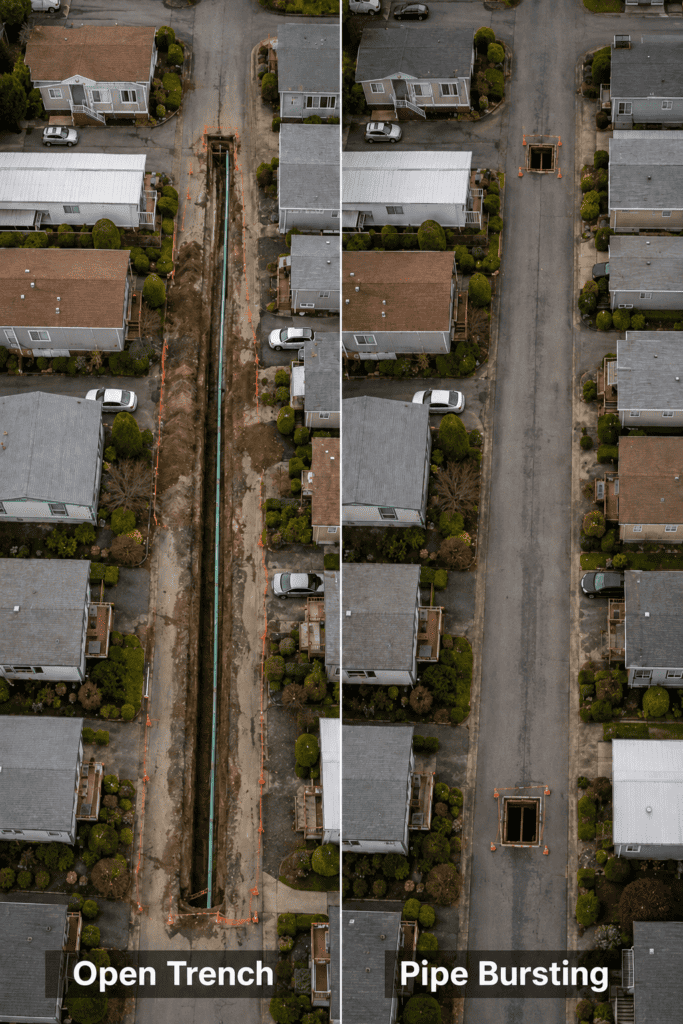
A manufactured home community compresses a lot of daily activity into a narrow corridor. The same road may provide resident access, emergency access, parking, deliveries, and the route for water, sewer, gas, power, and communications.
Traditional open trench replacement exposes the pipe along much of its route. It can be the right method when grade must be corrected or the line cannot be burst, but its effects can spread well beyond the trench.
The total project may include:
- Saw cutting and removing long sections of pavement
- Excavation near homes, carports, driveways, and other utilities
- Hauling and disposal of excavated material
- Imported backfill and compaction
- Temporary access or parking arrangements
- Pavement, curb, walkway, and landscape restoration
- More time with residents living around an active work zone
Homes cannot be moved out of the way, and relocating residents is not a practical plan. If the only road is opened for a long trench, access becomes part of the job.
This is why comparing only the pipe-installation price gives an owner a weak number. The surface above the line and the cost of disrupting the property must be included.
What does trenchless pipe bursting look like in a mobile home park?
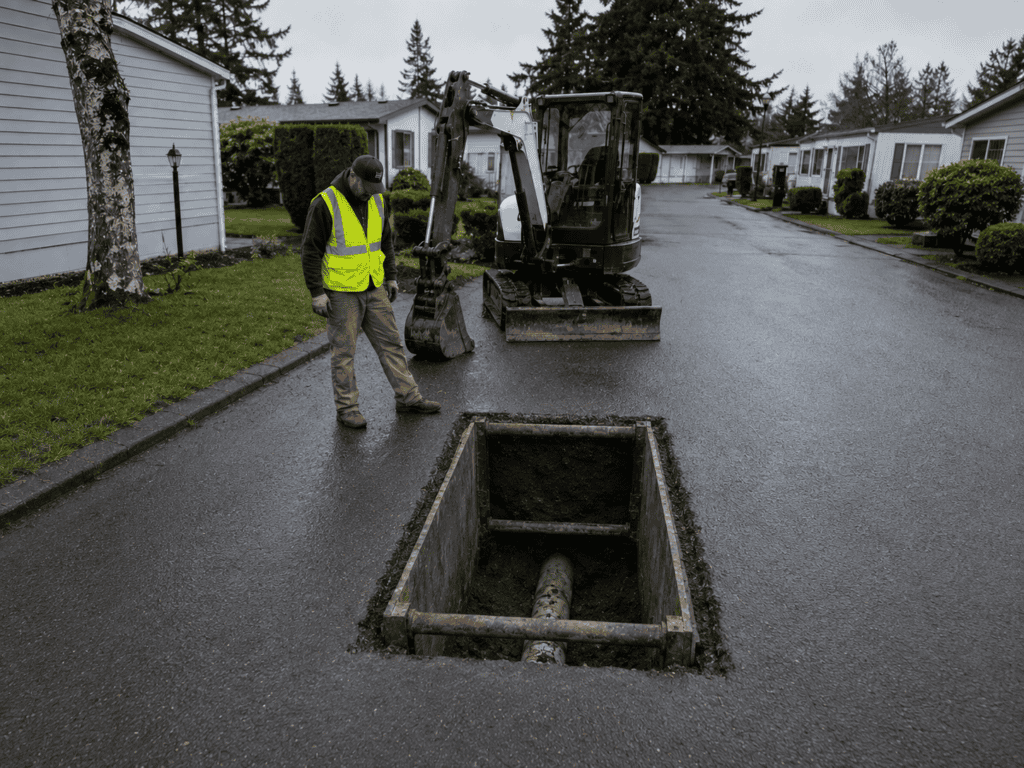
Trenchless pipe bursting replaces a failing line through its existing path. We excavate access pits at planned points, send a bursting head through the old pipe, and pull new pipe behind it.
Instead of opening the entire road, the work is concentrated at those pits. The exact layout depends on line length, pipe condition, grade, bends, connections, and other buried utilities.
The system can often be divided by main segment, loop, or branch. One section is replaced while the rest of the property remains in service. Connections are transferred, the new segment is inspected, and the pits are restored.
Service can often return to the affected section the same day, but that should not be promised before the system is mapped. Connections, access limits, or utility conflicts can change the work window.
Pipe bursting is not right for every segment. A serious belly, which is a low spot that holds water, may require excavation to correct the grade. Open trench may also be better where the route must change.
A mixed plan is sometimes the right answer. Burst the long, suitable runs and excavate only the sections that need grade correction or detailed connection work.
How should owners compare mobile home park sewer line replacement costs?
Start with total installed cost, not the contractor’s pipe price. Then divide the complete project cost by the number of lots or system branches that actually benefit from the work.
An honest comparison should place the same items in both columns:
Investigation, mapping, and video inspection
Permits and utility locating
Sewer installation
Service connection work
Traffic, parking, and resident access
Excavation and material disposal
Backfill and compaction
Pavement and landscape restoration
Inspection and closeout documentation
Expected downtime and management time
Warranty
Open trench may appear less expensive if road removal, repaving, and disruption are listed elsewhere. Trenchless may carry a higher underground price while reducing those surrounding costs.
There is no responsible universal cost per lot. A shallow run beneath open ground is not the same as a deep collector beneath the only paved road. The number is useful only after the system is scoped, located, and divided into work sections.
We perform our own video inspection before quoting a sewer line replacement. That lets us prepare a fixed lump sum bid around verified conditions. We very rarely have a change order because the investigation happens before the number is presented.
How can a park phase sewer rehabilitation across several budget years?
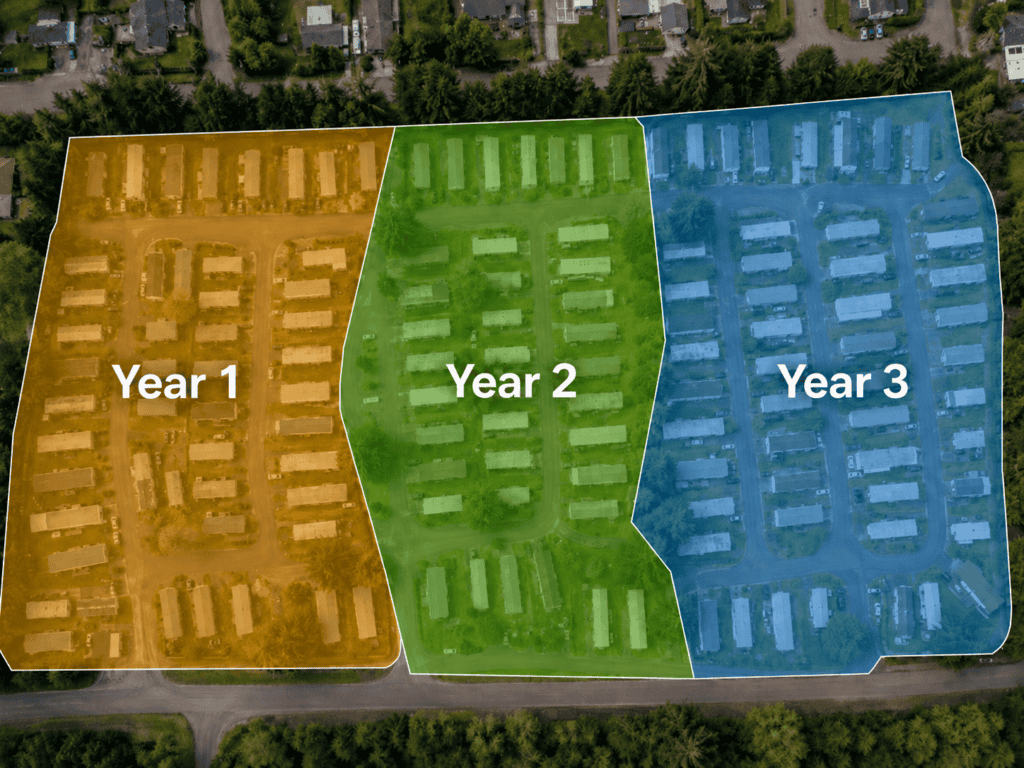
A full replacement in one year is not always necessary. A condition-based plan can spread a park sewer rehab in Oregon across two or three capital cycles.
The first phase should address lines with the highest consequence of failure. That usually means a collapsed or badly deformed collector, repeat backups affecting several spaces, severe root intrusion that returns after cleaning, or a segment beneath critical access.
The next phase can cover functional lines with growing structural defects. Stable sections with minor findings can be monitored and budgeted later.
A practical capital plan should show:
- Each mapped segment and the spaces it serves
- Pipe material, size, approximate depth, and access points
- Visible defects and inspection date
- Backup and maintenance history
- Consequence if that segment fails
- Recommended method and restoration needs
- Priority year and planning allowance
This gives owners and lenders a reason for the sequence. It keeps the most vocal complaint from controlling the budget over the most serious defect.
Phasing works only if the boundaries make construction sense. Replacing one short piece while leaving a failing downstream segment does not protect the investment. The plan must follow how the system actually carries flow.
What documentation should ownership and lenders receive?
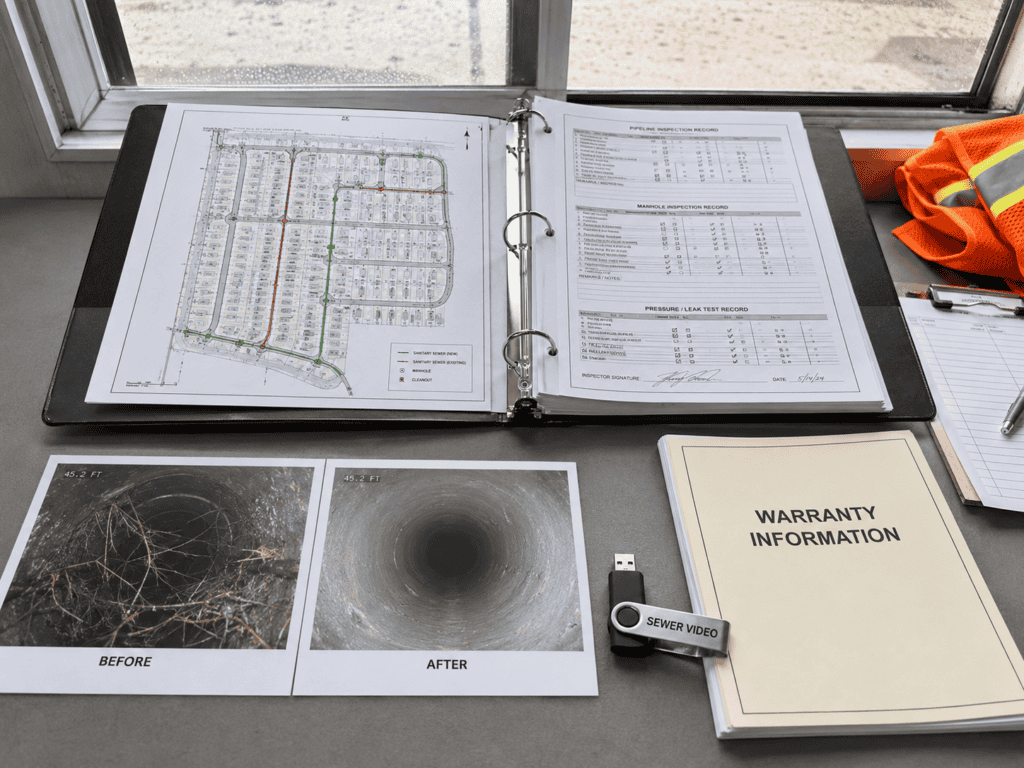
A manufactured home community sewer infrastructure project should leave a record the next manager can understand. An invoice and a sketch are not enough.
Before construction, the owner should receive video, a map of inspected segments, marked defects, and a written scope. Any section the camera could not pass should be identified.
After construction, the closeout package should include:
- Post-installation video of the completed line
- A record of the new pipe material and size
- Locations of access pits and reconnected services
- Permit and inspection records
- Photos of restoration
- Warranty information
- Notes on sections that remain and their recommended review dates
Before-and-after video documents why the expense was justified and what ownership received.
Our commercial underground services include the investigation, construction planning, and documentation needed for larger private systems. The same records also give future contractors a reliable starting point.
What happens during a park sewer site walk and evaluation?
A useful evaluation begins above ground. We review access, pavement, home spacing, cleanouts, utility routes, prior repairs, backup locations, and areas that cannot be blocked.
Existing plans and maintenance records must be checked against current conditions. Video inspection and locating show what is visible inside the pipe and where key defects sit.
We also ask operational questions:
Which spaces have had repeat trouble?
How often has the same line been cleaned?
Where has pavement already been opened?
Which roads must stay passable?
Are there planned paving or utility projects?
Does ownership need one project or a phased capital plan?
The result should identify what can wait, what comes first, which method fits each section, and what information is still missing.
Build the plan before the next backup builds it for you
If repeat sewer work is consuming the maintenance budget, we can walk the property, review the records, inspect the accessible lines, and separate urgent defects from sections that can be phased. The evaluation and estimate are free, with no pressure. Call (503) 747-9312 or request a free estimate.