Compare the Full Cost of Sewer Replacement in Portland
You have two bids for a failing sewer line. One proposes digging across the yard. The other proposes trenchless replacement. The total on each bid seems like the obvious way to choose until you consider the cost of restoring the driveway, irrigation, walkways, and landscaping.
That is the real question behind trenchless sewer repair cost in Portland. The pipe is only part of what you are paying for. Access, permits, inspections, surface restoration, and the time your property is disrupted can change the comparison.
At Black Rock Underground, we want homeowners to see the complete scope before choosing a method. Sometimes pipe bursting saves a great deal of surface work. Sometimes digging is the more practical answer. Here is how to tell which bid really covers your property.
What to know
The right method depends on the pipe, its route, nearby utilities, and the site.
Compare the final condition of your property, not just the pipe installation price.
Trenchless pipe bursting still needs access pits and may need some restoration.
A lower excavation bid can grow if concrete, irrigation, landscaping, or traffic control is excluded.
What are you actually buying with each method?
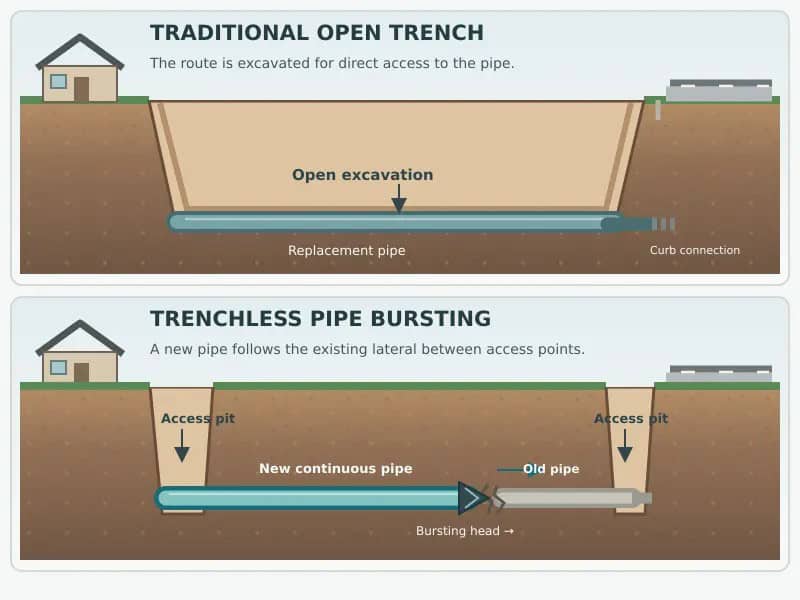
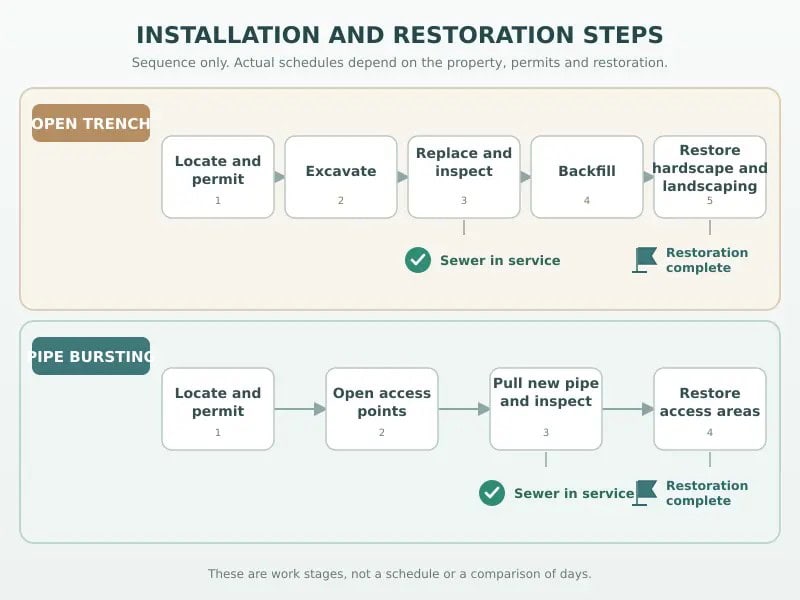
With a traditional open trench, a crew excavates along the section of sewer line being replaced. That gives direct access to the pipe. After installation and inspection, the trench is backfilled, and any affected lawn, planting beds, pavement, or other surfaces need to be restored.
With residential pipe bursting, a crew makes access excavations, typically near the ends of the section being replaced. A bursting head travels along the old pipe’s route, breaking it apart while pulling a new pipe into place. The yard between those access points can often remain largely intact. Connections and site conditions may call for additional excavation, so “trenchless” does not mean “no digging.”
Both methods replace a sewer line. Neither should be selected from a sales description alone. A camera inspection, the location and depth of the failure, the pipe’s route, and what lies above and beside it all matter. If you have an older Portland house, its sewer line may have been repaired or replaced since the house was built. An inspection can help establish what is actually there.
Compare the complete bids, not just the prices
There is no honest flat price for either method. Length, depth, access, pipe condition, nearby utilities, surface materials, permit requirements, and the location of the connection can all change the work. A generic online price range cannot tell you what replacing the line at your house will cost.
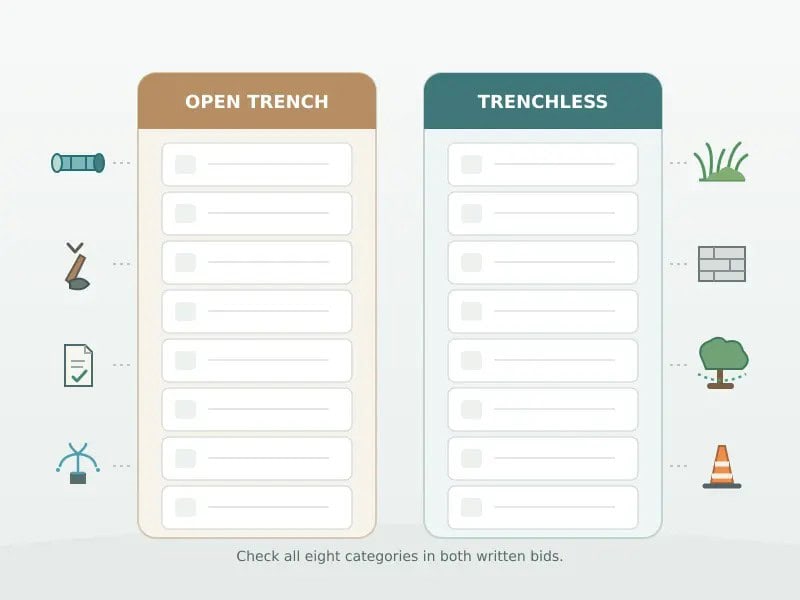
When you compare bids, ask each contractor to account for the same things:
Inspection and locating: Has the problem been located, and can you see the camera footage?
Pipe installation: How much pipe is being replaced? Where does the new section begin and end?
Access and excavation: How many pits or trenches will be needed, and where will they be?
Permits and inspections: Who obtains the permits, pays the fees, and schedules inspections?
Surface restoration: Who repairs the lawn, planting beds, concrete, asphalt, pavers, or fencing?
Utilities and irrigation: How will utility conflicts, irrigation repairs, and reconnections be handled?
Street or sidewalk work: Will traffic control or restoration in the public right-of-way be needed?
Unexpected conditions: What findings could change the price, and how would you approve that work?
The comparison only works if both bids cover the same length of pipe and leave the property in a comparable condition. If one contractor includes final restoration and the other stops at backfill, the prices are answering different questions.
The yard can be the expensive part
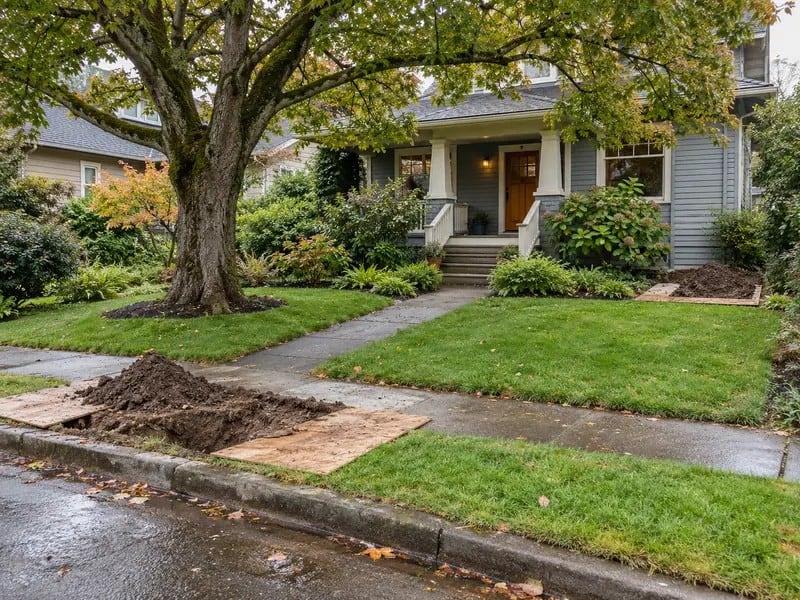
Imagine the old line running beneath a lawn, an irrigation zone, a walkway, and a mature tree. Digging out the pipe may be straightforward underground, yet rebuilding what sat above it is a separate job. Sod or seed may need time to establish. Irrigation lines and sprinkler heads may need repair. A cut driveway or walkway needs a specified finish. Pavers have to be removed and reset. Retaining walls, fences, and planting beds may complicate access.
Tree work deserves its own question. A mature tree cannot simply be replaced with an equivalent tree after construction. Ask whether the proposed trench crosses its root area and what the excavation plan would mean for the tree. Do not assume every trenchless job saves every tree either. The access pits must still go somewhere.
Cory remembers a homeowner with an old concrete sewer line full of roots. It kept backing up, and another contractor had been jetting the line about once a month without recommending a lasting solution. She had received a bid to dig a trench across her landscaped property, where mature trees stood in the proposed path. She did not know a trenchless option existed. Our crew replaced the line using one access excavation at the house and another in the street. Her landscaping and trees remained.
That story is not a promise that another yard will work the same way. It shows why the surface above the pipe belongs in the cost discussion from the start.
In Portland, the location of the work also affects permits. Sewer lateral work on private property requires a plumbing permit, while a repair in the public right-of-way generally requires a Utility Repair permit. A project crossing both areas can require both. Ask how permits, inspections, sidewalk work, and any required traffic control appear in the bid.
How much time will the property be disrupted?
Time has a cost even when it never appears as a line item. A trench across the yard can affect access, parking, pets, deliveries, and the way your family uses the property. There is also a difference between “the new pipe is installed” and “the concrete is repaired and the yard is usable again.”
Pipe bursting can reduce the area that has to be opened and restored. That may shorten the period of visible disruption, especially where a line runs beneath established landscaping or hardscape. It does not guarantee a one-day project. Permits, utility coordination, inspections, weather, and the restoration schedule still matter.
Open trench work is not automatically a drawn-out project either. A short, accessible section with simple restoration may be fairly direct.
Ask both contractors when the sewer is expected to be back in service and when all included restoration will be finished. If the work reaches the street, ask when access and parking will return to normal. A realistic schedule is more useful than a blanket promise that one method is always faster.
When digging is the right answer
We approach sewer line replacement based on what the property needs, and sometimes that means excavation. A short section of damaged pipe in an open area may be easier to reach directly. A sewer route may need to change instead of following the existing pipe. An obstruction, utility conflict, connection detail, or other site condition may make bursting unsuitable for part or all of the job. Selective digging may also be needed alongside a trenchless installation.
That is why the first useful question is not “Which method do you sell?” It is “What does the inspection show, and why does this method fit this line?” Ask the contractor to mark the proposed route and all excavation areas on a simple site sketch. You should know what will be opened before a machine arrives.
Read the exclusions before choosing the lowest bid
A fixed total is only as clear as the work behind it. Read the scope and exclusions closely. Does “restore yard” mean rough grading, topsoil, seed, sod, or replacement of specific plants? Does “concrete repair” mean a patched section or a larger matching area? Who handles irrigation testing after the work?
Then look for change-order language. Some changes are legitimate because a buried condition cannot be confirmed before excavation. The important point is how the contractor will document it, explain the options, and get your approval before charging more. Ask what conditions are already accounted for in the price and what would trigger an added charge. Get the answer in writing.
If the full project cost is a strain on your budget, Black Rock Underground has financing options. Make the repair decision from the inspection and complete scope first, then consider how to pay for it.
Frequently Asked Questions
Is trenchless always cheaper than digging?
No. The installation bid may be higher or lower. Compare the full job, especially surface restoration and any exclusions, before deciding which costs less for your property.
Will pipe bursting leave my yard untouched?
No. It requires access excavations and sometimes additional digging for connections or site conditions. It can preserve much of the area between access points when the line is a good fit for the method.
Does the cheaper bid include permits and restoration?
Only if the written scope says so. Ask each contractor to identify the permit responsibility, inspection work, and exact condition in which the lawn, pavement, and other affected surfaces will be left.
Can I compare bids if the contractors propose different methods?
Yes, but first confirm that both cover the same pipe length, address the same problem, and include comparable restoration. Otherwise, you are comparing two different projects.
Get a clear picture of the whole job
If you are weighing trenchless replacement against an open trench, we can inspect the line, explain the options, and show where excavation and restoration would be needed. Call (503) 747-9312 or request a free sewer evaluation.