
Portland’s Aging Sewer Lines Are Reaching a Breaking Point
Many Portland homes built before 1970 still rely on their original sewer lines. After decades underground, those pipes are becoming more vulnerable to cracks, root intrusion, corrosion, and collapse. Homeowners who understand what’s happening can identify problems early and avoid a more disruptive sewer emergency.
If your Portland home was built before 1970, the sewer line beneath it may be more than 60 years old. That does not automatically mean you need an old sewer line replacement in Portland, OR, but it does mean the pipe is old enough to deserve a closer look.
A backup is often the first time a homeowner thinks about the sewer line. By then, the real problem may have been developing underground for years.
At Black Rock Underground, we would rather show you what is in the ground and explain what it means than tell you to replace a line based on the age of the house alone. Some old lines still work well. Others are one root intrusion or shifted joint away from another backup.
What to know
A sewer line installed in 1965 is about 61 years old in 2026.
Pre-1970 homes may have concrete, clay, cast iron, or Orangeburg sewer pipe.
The joints often cause trouble before the pipe material itself wears out.
A sewer scope and the property’s permit records can tell you a lot without digging.
Why are so many older Portland sewer lines having problems now?
The math is simple, but most homeowners never have a reason to do it. A house built in 1950 is now about 76 years old. A house built in 1965 is about 61.
The sewer line may not be exactly the same age as the house. It could have been replaced, repaired, or partially updated. Unless there is a permit or invoice showing that work, you should not assume it happened.
That leaves many Portland-area homes connected through original pipe installed several decades ago. Age is not a diagnosis. It is a reason to gather better information.
The important question is not simply, “How old is my sewer line?” It is, “What material is it, what condition is it in, and has anything moved?”
What kind of sewer pipe is under a pre-1970 home?
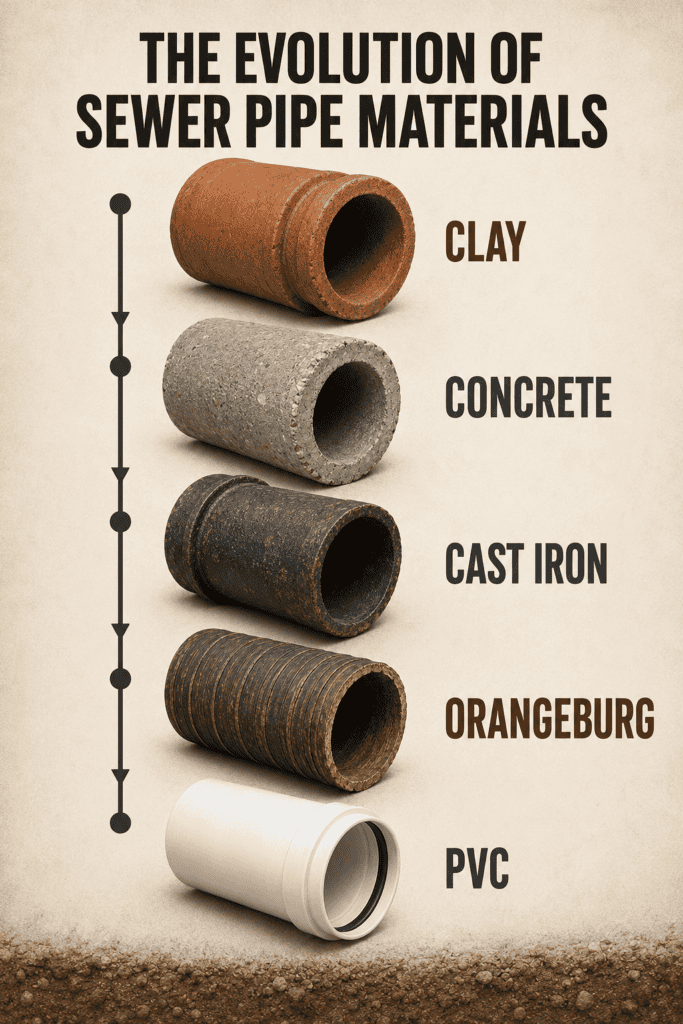
Older Portland homes commonly have one or more of four materials in the private sewer lateral, the pipe connecting the house to the public sewer system.
Concrete
Concrete pipe is strong, and municipal planning figures often place its useful life around 70 to 100 years. That number can be misleading for a line made from short, rigid sections.
The concrete itself may still be solid while the joints between sections leak, shift, or open enough for roots to enter. Once that starts, a structurally sound piece of pipe can still produce repeat clogs and backups.
Vitrified clay
Clay pipe has been used successfully for a very long time. Well-bedded clay has remained in service for more than a century in some systems.
Its weak points are brittleness and movement at the joints. If the soil settles or a root pushes against the line, one section can shift out of alignment with the next. That creates an offset joint, which means the openings no longer line up cleanly.
Cast iron
Cast iron is more common near the house and beneath foundations, though it may extend farther on some properties. Corrosion, internal scaling, cracks, and rough surfaces become more likely as it ages. A rough interior catches paper and waste more easily.
Orangeburg
Orangeburg is a fiber pipe made from layers of wood pulp and pitch. It was used for sewer laterals from roughly 1948 into the early 1970s.
It was marketed around a 50-year service life under ideal conditions, but real-world failures often happened much sooner. The pipe can soften, flatten, blister, deform, or collapse. If a scope confirms Orangeburg, the material and its present shape matter more than the age printed on a chart.
The joints often fail before the pipe does
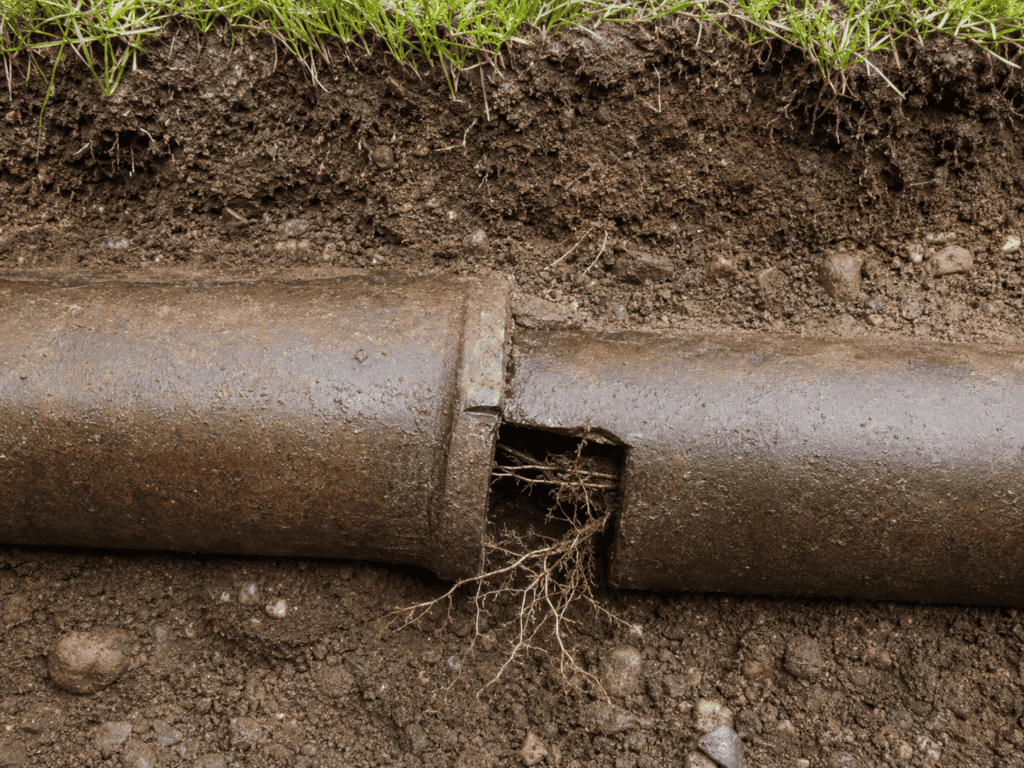
Concrete and clay sewer lines were installed in short, rigid sections. Each section connected to the next through a bell-and-spigot joint, where the narrow end of one pipe fit into the wider end of another.
Those joints are where many old sewer problems begin.
Small gaps let moisture escape and roots enter. Fine roots grow toward that moisture, then become thicker inside the line. They catch debris and can eventually fill much of the pipe.
Ground movement can also push one section lower or sideways. An offset joint creates a ledge inside the line. Waste catches on that ledge, and the opening may become smaller over time.
A belly is different. That is a low section of pipe where water sits instead of flowing downhill. A belly can collect solids and cause recurring trouble even when the pipe has no major crack.
This is why a lifespan chart cannot tell you whether to replace a sewer line. Two lines of the same age can be in completely different condition.
Why Portland conditions are hard on old sewer lines
Portland’s climate does not create every sewer problem, but it can expose weaknesses that are already there. The National Weather Service says nearly 90 percent of Portland’s annual rainfall occurs from mid-October to mid-May.
Long periods of rain saturate the ground. In fine-grained soils, water drains slowly and the soil can shift or consolidate. A rigid line may settle if its bedding was uneven or soil washed away near a leaking joint.
Then there are the trees. Mature trees are one of the things people love about older Portland neighborhoods. Their roots do not normally break into a completely sealed, sound pipe. They take advantage of an opening that already exists, then make the defect worse.
Wet ground, aging joints, and large root systems are a rough combination. A line may work through the summer and start acting up after the rainy season begins.
How can you find out what you have without digging?
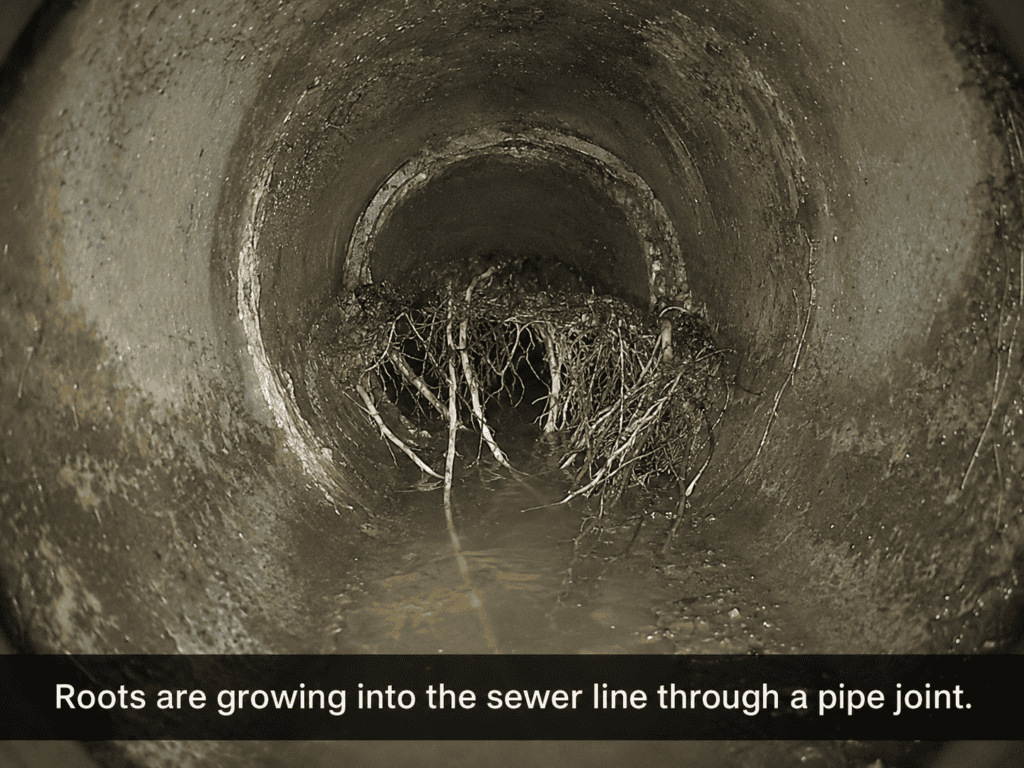
Start with a sewer scope inspection. A camera travels through the line and records the inside of the pipe.
A good scope can identify:
- The visible pipe material
- Root intrusion
- Offset or separated joints
- Cracks and broken sections
- Standing water that may indicate a belly
- Deformation or collapse
- Older spot repairs and changes in material
You can also check the property’s records. The City says sewer connection records and available plumbing permits can be found by searching the address in PortlandMaps. Records may show a replacement or repair, although older or unpermitted work may not appear.
Use both sources. Permit records tell you what was documented. The camera tells you what is there now.
Does an old sewer line need to be replaced right away?
Not always. You may have time if the line is still round and open, water flows normally, the joints have only minor movement, and there is little or no root intrusion. Keep the footage and compare it during a later inspection.
The signs that deserve faster attention include:
Sewage backing up into a tub, shower, or floor drain
Several fixtures draining slowly at the same time
Repeat clogs in the same section of line
Heavy roots that return after cleaning
A badly offset joint that blocks part of the opening
A flattened Orangeburg line
A crack, missing section, or partial collapse
Standing water caused by a significant belly
A sewage smell or consistently soggy area in the yard
One slow sink is usually a problem near that fixture. Several fixtures backing up together point more strongly toward the main sewer lateral.
Old sewer line replacement in Portland, OR, is easier when you can plan it
If a scope shows a line is near failure, replacing it on your schedule gives you choices. You can compare the actual scope findings, review the proposed method, plan for access, and understand what will happen to the property.
An emergency backup removes that breathing room. You may also be dealing with cleanup and unusable plumbing.
Portland property owners are generally responsible for the lateral between the house and the curb on a typical curbed street, including the section beneath the sidewalk and parking strip. The boundary differs on some curbless or unpaved streets, so the property should be checked rather than relying on a general rule. The City explains those responsibilities in its guide to broken sewer and drain lines.
If the City formally notifies an owner of a break or leak, the owner has 30 days to make the repair or request additional time. Planning before a line reaches that point puts you in control of the timing.
What trenchless pipe bursting changes
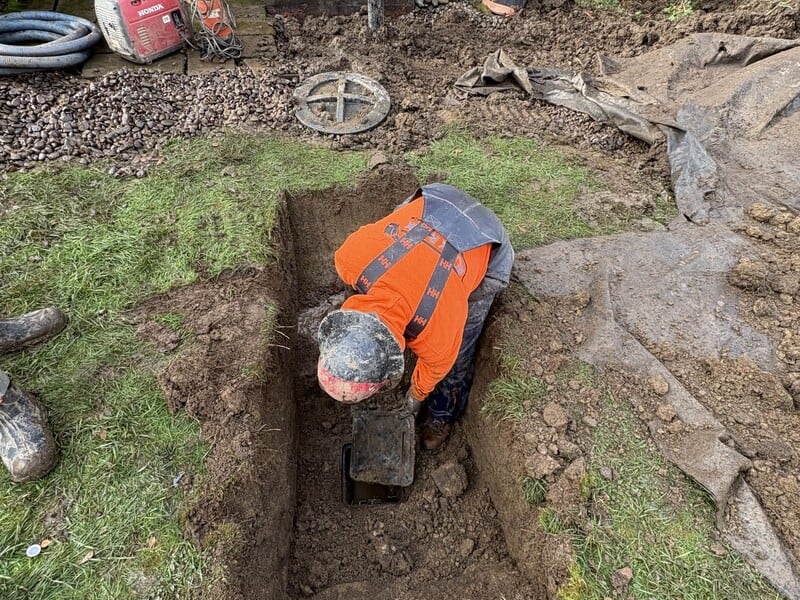
Many homeowners put off sewer replacement because they picture a trench running from the house to the street. Depending on the route, that could affect the lawn, landscaping, driveway, walkways, and mature trees.
Trenchless pipe bursting changes that calculation. We typically make one small access pit near the house and another near the street. A bursting head travels through the old line, breaks it outward, and pulls a new pipe into the same path.
The method can replace concrete, clay, cast iron, and Orangeburg lines while avoiding a full-length trench. It is especially useful beneath landscaping or hardscape.
Trenchless is not right for every property. A badly bellied line, an unsuitable route, utility conflicts, or a need to correct the grade may make open trench excavation the better call. The scope and locate should decide the method.
We run our own video inspection before quoting a sewer line replacement. That lets us base a fixed lump sum bid on what is actually underground instead of starting with a low number and adding surprises later.
Find out what is underground before deciding
The age of your home is a reason to inspect the sewer line, not proof that it needs replacement. A camera can show whether the line is doing its job, needs monitoring, or needs a repair plan.
We will inspect the line, explain what the footage shows, and give you a free evaluation without pressure. Call (503) 747-9312 or request a free estimate.